Showing posts with label Education. Show all posts

Do I Have COVID-19, The Flu Or A Cold?

WHO declares COVID-19 a global pandemic - What to do if you have symptoms and are worried you've been exposed to COVID-19.


GENEVA, Switzerland -- The World Health Organization (WHO) officials believe the rate of Coronavirus (COVID-19) cases is going to get worse before things start to get better. If you feel sick, when should you get tested?

Here are some basic facts about the virus, its symptoms, prevention, and what to do if you believe you are infected.

To activate this feature, press the "CC" button.

What are the symptoms?

Unfortunately, the initial symptoms of COVID-19 are very similar to the seasonal flu and even the common cold, so you may not know whether you are infected with Coronavirus - COVID-19.

The symptoms can include:
- Fever.
- Cough.
- Difficulty breathing.
- Pneumonia in both lungs (which would be seen on a chest X-ray).

Not everyone who is infected with COVID-19 has symptoms, and some people will only exhibit very minor symptoms.

"About 80 per cent of people will not get really sick from this," Dr. Samir Gupta, a respirologist, told CBC News.

The only way to confirm COVID-19 is with a lab test. Symptoms may appear as soon as two days after exposure or as long as 14 days after exposure.

The flu vaccine will not protect you against COVID-19.

What should you do if you have symptoms?

If you are under 50 years old and otherwise healthy, just stay home and take care of yourself. Definitely don't go to hospital, says Dr. Andrew Morris, an infectious disease specialist.

To activate this feature, press the "CC" button.

"The hospital's like the worst place for anyone, other than people who are really sick and who will need hospitalization. Just being infected with a viral infection is not a reason to go to hospital."

But it is a good reason if you are older, have a compromised immune system, or are experiencing shortness of breath.

The most important thing to do is to call ahead to your health care-provider when possible, whether you are going to see your primary care physician, a walk-in clinic, or an emergency department at a hospital. Upon arrival, you will be asked to wear a mask while waiting to prevent spreading your germs and you may be isolated... Read The Full Story on CBC News.

Coronavirus Map: Tracking the Global Outbreak.

Coronavirus - COVID-19 Tips with Captions:

4 Tips For Reducing Your Risk of Coronavirus COVID-19
Don't Make Your Own Hand Sanitizer: Infectious Disease Expert
Busting Garlic Cures and Other False Coronavirus Claims
Disease Control Expert Debunks Coronavirus Myths
Coronavirus Outbreak: Fact vs Fiction

Share this blog to your loved ones and friends to aware about COVID-19.

Related Coronavirus:
Learn The Signs For Deaf Coronavirus Patients
Do I Have COVID-19, The Flu Or A Cold?
Applause For ASL Interpreters Amid Pandemic

Related Posts: #DeafCommunity - #DeafNews

Signs of Solidarity for Deaf Black People

Gallaudet University Professor Explains Deaf African Americans' Unique Sign Language.


WASHINGTON, DC -- Carolyn McCaskill, a professor in Gallaudet University Department of ASL and Deaf Studies, explains how Deaf African Americans show their shared identity through their unique sign language.

Sign language, like spoken language, has regional variations (people sign more slowly in the South, for example), as well as features that reflect gender, age, socioeconomic status and, it turns out, race.

To activate this feature, press the "CC" button.

At 15, Carolyn McCaskill transferred to an integrated school, where she saw white students using one hand rather than two to convey terms such as “why” and “don’t know” and employing entirely different signs for everyday words.When she went home, she switched again to reassimilate to her own black culture, recalled McCaskill, who was on the panel.

McCaskill’s code-switching remains a common experience for Deaf black students, who often change to accommodate whites... Read The Full Story.

Related Story: Black American Sign Language and American Sign Language Are Different Languages.

Subscribe to https://youtube.com/channel/washingtonpost on YouTube.

Follow @WashingtonPost:
Facebook: https://facebook.com/washingtonpost
Instagram: https://instagram.com/washingtonpost
Twitter: https://twitter.com/washingtonpost

Related Carolyn McCaskill's sister Angela McCaskill:
Angela McCaskill Placed On Administrative Leave From Gallaudet
Gallaudet University Put Dr. Angela McCaskill for Opposing Gay
Gallaudet Official's Lawyer Speaks About Petition
Dr. Angela McCaskill - Press Conference
Intersectionality, Identity & Angela McCaskill
ABC7 Exclusively Interview With Dr. Angela McCaskill
Gay Marriage Opponents Have No Plans To Pull Ad Featuring Gallaudet Official
Black American Sign Language and American Sign Language Are Different Languages

Related Posts: #DeafAmericans - #DeafHistory - #GallaudetUniversity

How Technology Can Enrich Deaf Lives

Talks at Google - Nyle Dimarco: How technology can enrich Deaf lives.


SAN FRANCISCO, California -- This is a historical event for Talks at Google, because it is completely conducted through American Sign Language (ASL).

Model, actor, and activist Nyle DiMarco sits down with Google during our annual Accessibility Week to talk about Deaf culture, the mission and vision behind his foundation, and ways to reduce language deprivation for Deaf and Hard of Hearing children through technological solutions. DiMarco discusses the need to include Deaf people in the process of new technological implementations and how important of an impact that will make on our world.

To activate this feature, press the "CC" button.

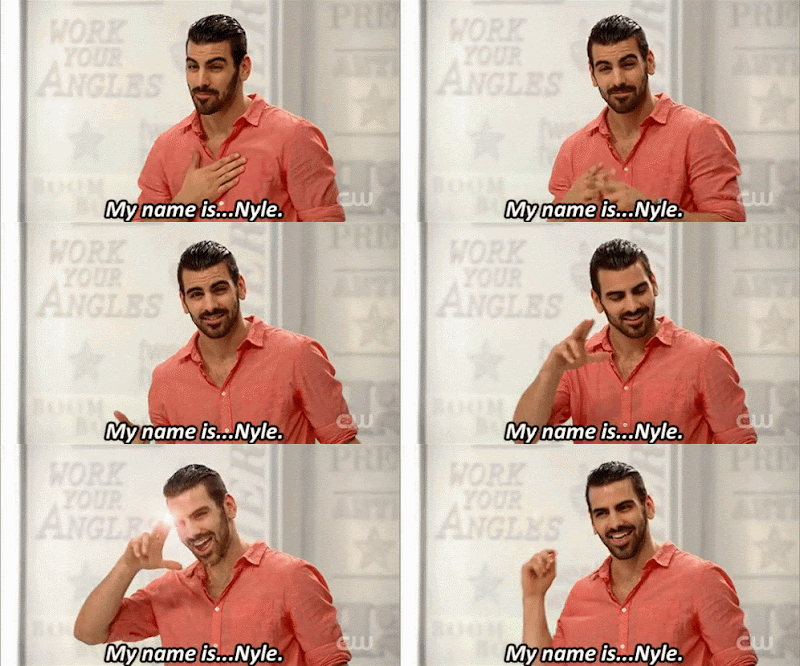
Nyle DiMarco has been breaking down barriers and winning over audiences since 2014. As a fan favorite on cycle 22 of America's Next Top Model, he became the second male winner and first Deaf contestant on the hit CW series.

The following year, partnered with Peta Murgatroyd, he took home the coveted mirror ball trophy on season 22 of ABC’s Dancing With the Stars.

DiMarco has quickly become the face of not only the Deaf community but disabled people worldwide (1.4 billion people with disabilities worldwide and 466 million people with hearing loss). He founded The Nyle DiMarco Foundation, which focuses on bilingual education and aims to improve access to accurate information about early language acquisition.

DiMarco is an inspiration to many and speaks all over the world, spreading the word of inclusion and acceptance. As a producer, Nyle is working on various scripted and non-scripted projects with the overall goal of telling new stories and empowering disabled people both in front and behind the camera.

Subscribe: https://www.youtube.com/channel/talksatgoogle.

Follow @NyleDiMarco:
Subscribe: https://youtube.com/nyle222
Facebook: https://facebook.com/nyledimarco
Instagram: https://instagram.com/nyledimarco
Model Mayhem: https://modelmayhem.com/nyledimarco
Linkedin: https://linkedin.com/in/nyledimarco
Tumblr: https://nyledimarco.tumblr.com
Twitter: https://twitter.com/nyledimarco
Website: https://nyledimarco.com

Related Dancing with the Stars:
Nyle DiMarco Is Joining 'Dancing With The Stars'
Nyle DiMarco 'Dancing With The Stars' Recap
ET News: 'DWTS' Nyle DiMarco & Peta Murgatroyd
'DWTS' Contestant Nyle DiMarco Hospitalized
Nyle DiMarco Amazes On 'Dancing With The Stars'
AG Bell's Letter About Nyle DiMarco Controversy
Deaf Model Nyle DiMarco Hairstyle Tutorial
'DWTS' Season 22 Recap Clips of Nyle DiMarco
25 Things You Don’t Know About Nyle DiMarco
Nyle DiMarco Wants To Empower Others Who Are Deaf
Nyle DiMarco On The Ellen DeGeneres Show
Nyle DiMarco Slams Fox News 'Deaf and Dumb'

Related America's Next Top Model:
ANTM Cycle 22 Finale Winner Is... Nyle DiMarco !
Nyle DiMarco - The Mecca Of The Deaf Community
Deaf Male Model - Introducing Nyle DiMarco
Top Models Learn ASL For Deaf Contestant
DCW50 Interviews Deaf Top Model Nyle DiMarco
ANTM Cycle 22 'BOOTYful' Music Video - Nyle
'ANTM' Contestant Nyle DiMarco's ASL Phrases
'ANTM' Nyle DiMarco Comes Out As Sexually Fluid
The Homosexual Scandal In Deaf Community
DEAFestival SWAG & Stilettos Fashion Show
ANTM: Nyle DiMarco - Deaf Community Reactions

Related Posts: #DeafCommunity - #NyleDiMarco - #Interview - #Technology

Deaf Speaker Joanne Chester "Not Just Deaf"

TEDx Dun Laoghaire host the TEDx conference with Deaf activist and speaker Joanne Chester "Not just Deaf."


Activist, and speaker Joanne Chester is Deaf and an Irish Sign Language user. She is a Community Worker and Youth Worker with a passion for social justice. She featured in the “London Calling” documentary which was aired last May on RTE. In the light of the documentary, she campaigns for Access to Work in Ireland and for Deaf people to be included as equal citizens.

To activate this feature, press the "CC" button.

She says “There are many potential rising stars from the Deaf community who yearn to strive in society but they face barriers daily due to inadequate access and deep-rooted prejudices. With a shift in attitude, we can create a better society for us all”. This talk was given at a TEDx event using the TED conference format but independently organized by a local community. Read more at TEDxDunLaoghaire.

Related TEDx:
Making Education Accessible To Deaf Children

Related Posts: #DeafActivist - #DeafCommunity - #Interview - #Technology

Deaf Voters: Capitalism Versus Socialism

Why do Deaf Americans prefer socialism over capitalism, they could turn the United States into another Venezuela.


Decades after Capitalism seemed to have triumphed over Socialism, politicians are once again arguing about the merits and drawbacks of these opposing economic systems. Why are we still having this debate?

Andrew Puzder, former CEO of the parent company of Hardee's and Carl's Jr., explains the misconceptions that keep the debate alive.

To activate this feature, press the "CC" button.

Capitalism versus socialism. We can sum up each economic system in one line:

Capitalism is based on human greed. Socialism is based on human need.

Right?

No. You're wrong!

So wrong, it’s exactly backwards. And Andrew Puzder will prove it to you.

Been on Amazon lately? Each of the thousands of products Amazon offers represents the work of people who believe they have something you want or need. If they’re right, they prosper. If they’re wrong, they don’t.

That’s how the free market works. It encourages people to improve their lives by satisfying the needs of others. No one starts a business making a thing or providing a service for themselves. They start a business to make things or provide services for others.

Puzder speak from personal experience.

When he was the CEO of the company that owns Carl’s Jr. and Hardee’s restaurant chains, they spent millions of dollars every year trying to determine what customers wanted. If customers didn’t like something, we changed it-and fast, because if they didn’t, our competitors would (pun intended) eat them for lunch.

The consumer-that’s you-has the ultimate power. In effect, you vote with every dollar you spend.

In a socialist economy, the government has the ultimate power. It decides what you get from a limited supply it decides should exist.

Instead of millions of people making millions of decisions about what they want, a few people-government elites-decide what people should have and how much they should pay for it. Not surprisingly, they always get it wrong. Have you ever noticed that late-stage socialist failures always run out of essential items like toilet paper?

RELATED: Deaf Voters: Why Trump Won

Of course, this isn’t a problem for those who have the right connections with the right people. Those chosen few get whatever they want. But everyone else is out of luck.

Venezuela, once the richest country in South America, is the most recent example of socialism driving a prosperous country into an economic ditch. Maybe you think it’s an unfair example. I’m not sure why, but okay. We’ll ignore the fact that leftist activists celebrated it as a great socialist success right up until it wasn’t.

But what about Western European countries? Don't they have socialist economies? People seem pretty happy there. Why can’t we have what they have-free health care, free college, stronger unions?

Good question. And the answer may surprise you.

There are no socialist countries in Western Europe. Most are just as capitalist as the United States. The only difference-and it’s a big one-is that they offer more government benefits than the U.S. does.

RELATED: The Ugly Truth About The Democratic Party

We can argue about the costs of these benefits and the point at which they reduce individual initiative, thus doing more harm than good. Scandinavians have been debating those questions for years. But only a free-market capitalist economy can produce the wealth necessary to sustain all of the supposedly “free stuff” Europeans enjoy. To get the “free stuff,” after all, you have to create enough wealth to generate enough tax revenue to pay for everything the government gives away.

Without capitalism, you’re Venezuela!

Andrew Puzder.

SOURCE

Follow @Prageru:
Facebook - https://facebook.com/prageru
Twitter - https://twitter.com/prageru
Instagram - https://instagram.com/prageru

Related #Prageru:
The Ugly Truth About The Democratic Party
Deaf Voters: Why Trump Won
Deaf Voters: Capitalism Versus Socialism

Related Politics:
Dems Spurn Deaf Candidate Over Allegations
Why Deaf People Will Be Voting For Trump
Why Deaf People Should Obey President Trump
Why Deaf Americans Fear President Trump
Why Do Deaf People Fall For 'Fake News'
Marlee Matlin Slams Donald Trump ‘Retarded’
Deaf Voters: ‘Retarded & White America’ Rigged
The Ugly Truth About The Democratic Party
Deaf Voters: Why Trump Won
Deaf Voters: Capitalism Versus Socialism

How Gallaudet is Working to Reach Deaf Readers

How Gallaudet University is working to reach young, Deaf readers.


WASHINGTON DC -- There was once a curious little girl with bright pink hair who loved to climb trees. One day, the little girl met an old man, who gave her fruit from a baobab tree. The fruit was delicious. So the girl set off to find the tree.

We’re not going to tell you what happens next, though. Wouldn’t want to ruin the ending.

This story of the pink-haired child and her fruit-focused adventure is told through an app created in a Gallaudet University lab that aims to give Deaf children something quite valuable -- easy, early access to American Sign Language.

“People like me, Deaf people, don’t ask to be fixed,” said Melissa Malzkuhn, founder and creative director the Motion Light Lab. “We just ask to be able to thrive.”

In this lab at Gallaudet, the private university for the Deaf and Hard of Hearing in Northeast Washington, research and innovation turn into resources for children and families. There is so much out there for hearing children, Malzkuhn said through interpreters. But much of what is available is sound-based.

“Which is great, there’s been beautiful work done, lots of wonderful applications, but they have absolutely zero benefit for Deaf children, who are visually oriented,” Malzkuhn said. “So that’s where this lab comes in.”

Launched in 2009, the lab in recent years has developed “The Baobab,” the story of the young girl, which has been translated into Russian, Japanese and other languages. It is also home to similar projects known as VL2 Storybook Apps. There is “The Blue Lobster,” which follows the same adventurous child. “The Museum of Errors” features wordplay. “The Boy Who Cried Wolf” and “The Little Airplane That Could” are new spins on classic tales.

“There really aren’t that many resources out there for Deaf children,” Malzkuhn said. “Especially when you’re talking about technology.”

The bilingual storybook apps offer vivid, colorful illustrations of dogs and airplanes and pink-haired heroines. As the stories progress, children can press highlighted words for a video of someone signing and fingerspelling. They can also watch a video of a story told through ASL.

These Deaf men helped NASA understand motion sickness in space

The lab is also using motion-capture technology to develop a more authentic signing experience. A video of an ASL nursery rhyme, done in collaboration with a lab in Paris, shows why that matters: the system can create clear, expressive language delivered through a three-dimensional character.


Motion capture is used to show movement -- usually dance, sports, that kind of stuff. Capturing gestures, though, is a bit more complicated. Typically, Malzkuhn said, the lab’s system has about 50 markers, which are basically raised knobs placed along joints in the body. The lab uses more than 100 markers to make sure the finer points of gesture are preserved.

“I feel like a ninja, because it’s black and I have all these markers on, so I dress completely in black,” she said of the motion capture outfit. “The work is tedious, for putting the markers on the face, I will say that. Because you don’t just pull on a mask.” ... Read More at The Washington Post.

Related Posts: #GallaudetUniversity

Ten Deaf Children, One Powerful Message

Watch video sends powerful message about equal rights "10 Deaf Children, 1 Powerful Message" has become an internet hit.


Sheena McFeely also known as ASL Nook channel share a powerful message on YouTube -- Every day, Deaf people "fail" the hearing test immediately after being born, face "language delays" with their hearing family that don’t learn their natural language, and attempt "perfect speech" in order to fit into the Hearing world. They fight to use interpreters that benefit both the hearing and the Deaf, and deal with job discrimination -- all simply because they cannot hear.


Ironically, the practice of teaching signs to hearing babies is booming due to practical, emotional, and cognitive benefits validated by research. Hundreds of thousands of hearing people are taking American Sign Language (ASL) classes in high school as well as college -- making ASL the third most-studied language, according to Modern Language Association. Many come out of the experience proclaiming how beautiful ASL is.

Even while ASL is beautified, Deafness is still perceived as something that needs to be fixed. This makes Deaf people seem unequal, abnormal, and even defective. Deaf people are perplexed by this, as they see themselves as equal, diverse, and an attribute to this world.

"TODAY WE ASK, WHEN CAN YOU SEE US THE SAME WAY DEAF SEE THEMSELVES?"

It is our hope that this message will raise awareness, and at the same time, encourage Americans to join the Deaf community in the ongoing fight for equality.

SOURCE

Follow @ASLNook:
Blog - https://aslnook.com
Facebook - https://facebook.com/aslnook
Twitter - https://twitter.com/aslnook
YouTube - https://youtube.com/channel/aslnook

Related #ASLNook:
ASL Nook - McFeely Family's Introduction
The Internet Opens A Window To The Deaf World

Related:
Deaf Schools 'Home' (VIDEO)
Educate For Hearing Parents With Deaf Children/Toddlers
ASLized: Through the Hands
Creating Deaf Counternarratives With Commentary
Educate For Hearing Parents With Deaf Childrens/Toddlers
Importance of Educating Hearing Parents
Interview With Hearing Parents Of A Deaf Son
ASL Rose: Two Deaf Babies

Related Hearing Parents With Deaf Children:
Interview With Hearing Parents Of A Deaf Son
Educate Hearing Parents of Deaf Children
Early Language Acquisition of Deaf Babies
Deaf Awareness: One Deaf Child
American Sign Language For Babies & Toddlers
Cochlear Implants Is NOT A Cure !
Why Is It Important To Learn Sign At Birth For Deaf Child ?
Educating Hearing People About The Deaf World

Can Deaf People Hear Their Own Thoughts?

Can Deaf people hear their own thoughts? Dolan Life Mysteries.


Watch the most popular Super Planet Dolan channel on YouTube - From whether or not Deaf people can hear their own thoughts, to what the Sun is made out of, we answer 10 of your most burning questions about life.

Skip to 2:32 to 3:22 in one minute video clip with closed caption, EpicGaming001 asks can Deaf people hear their own thoughts? Dolan answers.

To activate this feature, press the "CC" button.

You can help support our animators (& earn some special bonuses like custom graphics, early video access and your questions featured in Q&A videos) by checking out our Patreon page: https://patreon.com/superplanetdolan

CREDITS - Starring:
Nixxiom https://twitter.com/nixxiom
Melissa https://twitter.com/melissaamorgan
Animated by JamesShark https://twitter.com/jamesharknado
Written by: Spinalpalm & Ashton P
Music/SFX by: Epic Mountain Music http://epic-mountain.com

Info sources: http://pastebin.com/sns6SfmP
Credits music: "Sugar Plum Dark Mix" Kevin MacLeod (incompetech.com)
Licensed under Creative Commons: By Attribution 3.0
http://creativecommons.org/licenses/by/3.0

SOURCE

Related:
How Do Deaf People Think ?
Animated Short Film 'Deaf in a Hearing World'

Related Documentary:
Deaf Awareness: Alone In A Deaf World
Deaf Awareness: Alone In A Hearing World
Ted Evans - In Search Of The DEAF WORLD
Living In Between The Deaf And Hearing Worlds
A Hearing Son In Deaf Family 'I'd Rather Be Deaf'
Life and Deaf - BBC4 Documentary
Through Deaf Eyes - Documentary Film
Living In Between The Deaf And Hearing Worlds
Deaf Awareness 'Voiceless' Short Film
VICE News: Deaf Culture 'Signs of Change'
Can Deaf People Hear Their Own Thoughts ?
Deaf Documentary Film: 9/11 Fear In Silence
The Deaf Holocaust - Deaf People and Nazi Germany
A&E: Born This Way Presents 'Deaf Out Loud'

How Do Deaf People Think ?

Benefits of being bilingual: Deaf people have voices in their heads? 'Today I Found Out' channel explains about bilingualism.


Watch a six minutes video of Simon Whistler the host show from Today I Found Out on YouTube channel - those who were born completely Deaf and only learned sign language will, not surprisingly, think in sign language.

To activate this feature, press the "CC" button.

What is surprising is those who were born completely Deaf but learn to speak through vocal training will occasionally think not only in the particular sign language that they know, but also will sometimes think in the vocal language they learned, with their brains coming up with how the vocal language sounds.

Primarily though, most completely Deaf people think in sign language. Similar to how an “inner voice” of a hearing person is experienced in one’s own voice, a completely Deaf person sees or, more aptly, feels themselves signing in their head as they “talk” in their heads.

Want the text version? http://todayifoundout.com/index.php.

Subscribe for new videos every day: https://www.youtube.com/todayifoundout

SOURCE - Today I Found Out

Related: Can Deaf People Hear Their Own Thoughts?

The Case For Bilingual Deaf Children - UConn

UConn researchers want to understand the science behind how early access to language affects learning in Deaf and Hearing children.


MANSFIELD, CT -- UConn Today: Marie Coppola and a number of other researchers at UConn want to understand the science behind how early access to language affects learning in Deaf and Hearing children. Deaf children are just as intellectually capable as hearing children – but if they do not have early access to language and communication, that intellectual capacity can quickly erode.

Eight-year-old Marie Coppola could hear the dial tone on the other end of the phone. Second ring … third ring. She was a little clammy, but not as nervous as the first few times she’d picked up and dialed on this sunny Philadelphia afternoon.

A middle-aged woman’s voice answered. “Hello?”

“Hello,” Coppola said, affecting what she thought was a deep, confident tone. “I’m calling about your ad in the Inquirer for cleaning services.”

The woman was not fooled. “Excuse me?” she began testily.

“It’s for my mother,” Coppola rushed on. “She’s deaf, but she is highly qualified and can provide references. If you’d like to meet her, I can arrange it. She’s available any afternoon this week …”

Amy Coppola, standing with a hand on her daughter’s shoulder, looked on. Her daughter trailed off, eyebrows furrowed. She tried a few more cajoling words, but finally mumbled, “Okay, thank you,” and hung up.

Her mother didn’t need to ask. “Better luck next time?” she signed.

“Yes,” signed Marie. She trudged across the room, disgruntled.

“I’m going to my room. I’ll be back for dinner,” she signed – in the Deaf custom of telling people where you’re going when you leave, and when you’ll be back – before disappearing down the hall.

Forty years later, Marie Coppola, now assistant professor of psychological sciences and linguistics in the College of Liberal Arts and Sciences, is still disgruntled. Even today, amid a surge of technology that promises to give Deaf and Hard-of-Hearing people access to sound, Coppola says Deaf people, along with their language and their culture, are not being heard.

Coppola was recently awarded a $1.2 million National Science Foundation (NSF) CAREER Award, one of the largest in the program’s history, to study the impact of early language experiences – whether spoken or signed – on how children learn. She hopes her work will help people better understand that sign language is just as worthy as spoken language... Read More: HERE.

California School For The Deaf Fremont

Hearing parents of Deaf children share story about the California School for the Deaf, Fremont.


The California School for the Deaf (CSD), in Fremont, is a free and public accredited school in the state of California that serves Deaf children.

The CSD has made a commitment to be a Deaf centered environment in which the design of learning and the language of instruction are consistent with a Bilingual-Bicultural approach to educating Deaf children.


The school values itself as a multi-cultural community of varied ethnic backgrounds through which people are able to learn and work together to promote the academic, linguistic, vocational, cultural, social, emotional and physical development of Deaf children. The involvement of parents, students, staff, the Deaf community, the business community and the community at large is regarded as essential to the mission of the school.

A safe, academic, Deaf-centered culture is nurtured at CSD. Dedication to students is the hallmark of CSD staff. Visit CSD website, http://csdeagles.com

SOURCE

Follow @CaliforniaSchoolfortheDeaf:
Facebook: https://facebook.com/csdthat
Twitter: https://twitter.com/csdeagles
Website: https://csdeagles.com

Related CSD, Fremont, Riverside: #CaliforniaSchoolfortheDeaf

DGM and NAD - Partners For Deaf Rights

Deaf Grassroots Movement and National Association of the Deaf as the partners for Deaf Rights in the United States.


WASHINGTON, DC -- Get outside and find a street corner on October 20th! Fight for our rights for access, education, and employment. Last week, the Deaf Grassroots Movement (DGM) and the National Association of the Deaf (NAD) met via videoconference.

To activate this feature, press the "CC" button.

We talked about how we can work together, build a relationship between DGM and NAD, and identify our plans for the future. The primary focus of our discussion was about October 20th. On that day, in 85 cities across America, people will stand at a street corner with signages to bring attention to three important issues for the Deaf and Hard of Hearing community: access, education, and employment.

Howard - DGM and the NAD work together and support each other. Allow me to explain how. The NAD has always met with the federal government to discuss various issues including education, employment, and access. While such discussions are productive, sometimes we get nowhere. Thanks to DGM’s movement and making noise about our needs, the federal government reached out the NAD recognizing the their actions. This helps the NAD continue the dialogue we want to have with the federal government. I am very appreciative of the work DGM has done to support the rights of deaf and hard of hearing people.

So, October 20th is a very important day! You can get involved by looking for the DGM Facebook page in your state, and find out details about October 20th. You can join for an hour, a few hours, or all day! Your time contributed to this movement will have an impact across the country! This movement will occur every now and then, not just October 20th, so we can remain visible and bring attention to the community including the politicians. We want them to know that we are still here!

SOURCE

Follow @NAD:
Facebook - https://facebook.com/nad
GooglePlus - https://plus.google.com/nad
Twitter - https://twitter.com/nad
YouTube - https://youtube.com/nadvlogs
Website - http://nad.org

Follow @DeafGrassrootsMovement:
Facebook - https://www.facebook.com/deafgrassrootsmovement
Official Website - http://deafgrassroots.wixsite.com/tdgm

Deaf Grassroots Movement Hastags:
Facebook: https://facebook.com/hashtag/dgm
Instagram: https://instagram.com/explore/tags/dgm
Twitter: https://twitter.com/hashtag/dgm

Related Deaf Deaf Grassroots Movement:
Deaf Grassroots Movement - National Deaf Rally
Deaf Grassroots Movement Nationwide Rally
Deaf Protest at White House in Washington DC
Deaf Protest At The White House 2015 Live Video

Deaf School Children Sign The 9/11 Story

Deaf school children in Texas use sign language to paint a powerful portrait of what happened on September 11.


NEW YORK CITY -- Teaching 9/11: “To them, it’s history, just like Pearl Harbor,” said Chris Causey, a middle school educator in Robertson County, Tennessee. So, as the memories fade, teachers feel challenged to teach 9/11 in some way that is relevant to all ages in the United States.

Deaf school children in Texas use sign language to paint a powerful portrait of what happened on Sept. 11.

In some schools in New Jersey, third graders learn about the K9 rescue teams while 12th graders discuss methods of prisoner interrogation. In Tennessee, older students at Stratford High School conduct a mock rescue at the World Trade Center; others arrange their desks like the seats of an airplane while Williamson County social studies teacher Kenneth Roeten asks students about their everyday morning routines and compares them to headlines just before the attacks.

“I personally cannot think of any other event in American history that has had more of an impact on how everyday Americans live their life,” Roeten wrote in an email. “It has had a profound impact on my life; therefore, I believe it to be my duty as an educator to never stop teaching the shock, horror, sadness and utter disbelief of that day.”

But how? That's what school systems around the country are wrestling with now.

“I don’t think there’s a school system that has said ‘We’re going to focus on this,'” said Colleen Tambuscio, a teacher at New Milford High School in New Jersey who helped write a 9/11 curriculum through the New Jersey Commission on Holocaust Education in collaboration with the National September 11 Memorial and Museum in Manhattan. “I think what has happened in New Jersey - we’ve had moments of silence; we’ve had commemorative acts that were important. But now we should be getting into the educational piece, where we’re doing more with the education. That’s the trajectory.”

The lessons from the curriculum Tambuscio helped write include political and religious discussions; the history and present state of Islamic extremists; the global impact of the day economically; the ensuing wars; the backlash against Muslims; the change in day-to-day security and privacy implications; the huge personal tragedy; as well as stories of the first responders, extraordinary acts by ordinary citizens and the mission of service many felt afterward... Read The Full Story.

Related Documentary:
Deaf Awareness: Alone In A Deaf World
Deaf Awareness: Alone In A Hearing World
Ted Evans - In Search Of The DEAF WORLD
Living In Between The Deaf And Hearing Worlds
A Hearing Son In Deaf Family 'I'd Rather Be Deaf'
Life and Deaf - BBC4 Documentary
Through Deaf Eyes - Documentary Film
Living In Between The Deaf And Hearing Worlds
Deaf Awareness 'Voiceless' Short Film
VICE News: Deaf Culture 'Signs of Change'
Can Deaf People Hear Their Own Thoughts ?
Deaf Documentary Film: 9/11 Fear In Silence
The Deaf Holocaust - Deaf People and Nazi Germany
A&E: Born This Way Presents 'Deaf Out Loud'

Booming Cochlear Implants in Indiana State

Deaf News: As more Deaf students use cochlear implants, Indiana schools work to adapt due to gaining popularity.


INDIANAPOLIS, IN -- Public schools in Indiana serve about 2,400 students who are Deaf or Hard of Hearing. Of those students a growing number now use cochlear implants, small medical devices that stimulate nerves in the inner ear and give a sense of hearing.

As technology develops, and cochlear implants become more common, many public schools are still working to catch up.

“I like to think that it’s not malicious, it’s just that most of these smaller districts don’t have the training and the knowledge to really be able to understand what these kids need,” says Ellyn McCall, family liaison at hearing loss advocacy group Hear Indiana.

As the number of students with cochlear implants grow, advocates like McCall say there’s often a disconnect between services schools offer and services these students need.

Brandy Hauser, of Spencer, IN, had never been more excited. She was a brand new mom. Like all Indiana parents since 1999, she watched as doctors took her newborn daughter Grace for a hearing screening.

Then a nurse came back.

“She [gave] me a little card and said that your daughter didn’t pass the infant hearing screening test,” Hasuer says.

Grace has mondini dysplasia, an inner ear malformation that results in profound deafness.

“After that it was like a whirlwind of ‘What do we do?,’” Hauser says.

For communication, the options can come from two schools of thought.

There’s the well-known route: use sign language. Or the newer option gaining popularity: cochlear implants and spoken language.

Hauser chose the second. At 18 months, Grace had an implant surgically attached to her skull.

“She was sitting in her little car seat stroller. We had her sitting up in there, and they turned her on. It was just like the shine of a Christmas light in her face when she, you know, clapped and she looked,” Hauser says. “It was the first time that I knew, ok, she looked. Ok, we’ve got this.”

But when Grace got to school, things became complicated. Hearing with cochlear implants is not traditional hearing. It takes time to ‘learn to hear.’

“When sentence writing started coming around, and the structure of sentences.. [It] was very hard for her to make a sentence that would be correct,” Hauser says.

Hauser says that’s largely because services from the school district weren’t geared for Deaf kids who, through technology, were also learning to hear and speak.

Instead, the focus was American Sign Language, where grammar is different.

Students like Grace are already outliers in the state. She’s one of nine Deaf or Hard of Hearing students in the Spencer-Ownens Community Schools district of 2,600 students. That’s one-third of one percent of the entire student body.

That’s typical for most Indiana school districts. Public districts, outside of the Indiana School for the Deaf, have eight deaf or hard of hearing students, on average.

Melissa Lancaster heads the organization that provides special education for Grace’s school district, Spencer-Owens Community schools.

“We look at what they’re needing and what services can we provide to meet that,” Lancaster says. “The only challenge is making sure that we’re up to speed on the cochlear implant and what’s needed with that.”

Challenges - and debates - around educating students who are Deaf and Hard-of-Hearing are nothing new to Indiana. Indiana is home to the Indiana School for the Deaf - an institution that specializes in giving students who are Deaf and Hard of Hearing an American Sign Language and English bilingual education.

As technology developed, lawmakers said the ISD was not giving students enough experience in a newly available hearing culture. School officials pushed back, but the state diverted funding from the school to create the Indiana Center for Deaf and Hard of Hearing Education.

It’s goal? Provide information regarding all communication opportunities to families, from American Sign Language to spoken language.

Deaf or Hard of Hearing students bring their districts about $8,000 each in extra state funding, but advocates say that amount doesn’t necessary cover expensive services that help students with cochlear implants, like therapy, closed-captioning and teacher microphone systems.

“That has to cover lot’s of things,” says Naomi Horton, executive director of hearing loss advocacy group Hear Indiana. “It’s not enough money in most cases to cover the special education costs.”

But there’s a catch. Under federal law, school districts are obligated to provide all students with a free and adequate education. In other words, they can’t say a necessary special education accommodation is beyond their budget. And she says, that can put cash-strapped schools in a tricky position.

Ellyn McCall, the family liason at Hear Indiana, says it makes a big difference when services are tailored for children with cochlear implants. She says it has made a big difference for her son Seth.

Today, Seth is 8 years old. He’s in a traditional classroom, and says he learns things like the definition of “busybody.”

“‘Busybody’ is when you’re being nosy and you’re listening to someone else’s conversation,” Seth says.

Because there is evidence that early services can mean big results for students like Seth in the long run, some parents don’t want to wait for their districts to provide them.

Kendra Bowden’s son Wyatt has cochlear implants. On his third birthday, Bowden says he still had the language skills of a child half his age.

Bowden lives in Terre Haute, but she decided to send Wyatt to St. Joseph Institute for the Deaf, a private school that specializes in educating children with cochlear implants. It’s in Indianapolis. An hour and a half away.

“We didn’t want to actually send him because it’s far for us, it’s far for him it’s hard on him it’s hard on us, he’s our baby he’s never even been to daycare,” Bowden said. “But that school is only there for preschool.”

It’s almost seven hours total of driving there and back, to and from school each day. But Bowden hopes it will be worth it after preschool.

“I think it’s gonna be worth it in the long run,” Bowden said. “It’s not forever, it’s maybe a couple of years.”

Studies show getting children with cochlear implants specialized services early can be worth if for the state financially, too. The state can save over $200,000 per student that would otherwise go to state services, like special education and auditory rehabilitation.

SOURCE - WBAA

#NoGoBritain - Failing The Deaf ?

WATCH [CC] - Deaf News: No Go Britain: Failing the Deaf in the UK?


LONDON, UK -- A new report from the National Deaf Children's Society (NDCS) says that, ten years on from the introduction of hearing screening for new-born babies, the benefits are being undermined by lack of support for Deaf children and their families. Three quarters of such children arrive in school lagging behind their peers in terms of development and, by their teens, they are almost twice as likely to fail to achieve five good GCSEs (General Certificate of Secondary Education).

To activate this feature, press the "CC" button.

In the third report of our series on the challenges faced by disabled people in Britain, Jackie Long has been finding out how some families cope.

To activate this feature, press the "CC" button.

Challenges for disabled people: welcome to No Go Britain - Disabled filmmaker Kate Ansell went to meet some of the people who are finding their ambitions thwarted, and have resolved to make 2016 the year they start breaking down the barriers.

SOURCE - Channel4News.

Follow @NoGoBritain:
Facebook - https://facebook.com/nogobritain/
Twitter Hashtag - https://twitter.com/hashtag/nogobritain
Website - http://channel4.com/news/no-go-britain

The First African Deaf University In Ghana

Deaf News: Ghana will become the second in the world to host Deaf University after America’s Gallaudet University in Washington.


ACCRA, GHANA -- The first ever University for the Deaf in Africa is to be constructed in Ghana to simplify education and communication in sign language on the continent.

The University, which is expected to be operational in about two years, will be situated on the Techiman campus of the Valley View University in the Brong Ahafo region.

The former president of the European Union for the Deaf, Jean-Francois Labes, made the disclosure during a courtesy call on the management of Excellence in Broadcasting Network (EIB) - operators of Starr 103.5 FM and a host of other media houses.

He said the University will bridge the gap between the hearing and the hearing impaired as far as “education is concerned.”

According to him, the facility will run as a mainstream university which will have faculties such as data processing, business, law and medicine as well as vocational departments among others. The University will be opened to all Deaf students in Africa.

J. F. Labes, who communicates in the sign language, told Starrfmonline.com he bought into the idea after officials of Mieux Vivre Foundation mooted it to him since he had helped establish schools for the Deaf in France – his home country – and in Morocco.

He was full of praise for the “exceptional” Vice Chancellor of Valley View University Prof. Robert Osei-Bonsu, who immediately offered a 50-acre space to construct the University for the Deaf. He stressed that the university is going to be autonomous, despite being on the campus of Valley View University.

“I’m so impressed that we have signed a Memorandum of Understanding (MoU),” J. F. Labes, who is also the president of Unisda said. “We chose Ghana because it is a stable country and peaceful since it is the first in sub-Saharan Africa to attain independence.”

He announced that Ghana will become the second in the world to host such facility after America’s Gallaudet University in Washington.

A sponsors’ gathering is expected to be held in September in Ghana to appeal for funds for the ground-breaking initiative. Stakeholders including MPs, officials in the education sector and office of the president are scheduled to grace the occasion.

“We want to make sure that everyone including the Deaf will have equal access to education. Persons with hearing impairments are more in Africa and in Ghana alone they make up 7% of the population. There is the need for education for those people hence our resolve to come up with the University,” he noted.

He noted that all stakeholders including the schools of the Deaf in Ghana, national association of the Deaf have all been involved in the project.

Accompanying J. F. Labes to EIB Network were officials of Evanmike Multi Company Limited – the firm helping with negotiations – Aaron N’Kiambi-Yavanga, Akouate Fianou, the secretary general and vice president respectively of Mieux Vivre Foundation and Sara Minneboo, the interpreter.

SOURCE - StarRfmonline

Saskatchewan Needs More ASL Interpreters

Deaf News: The Deaf Canadian community feels marginalized in Saskatchewan, says human rights report.


REGINA, SK -- The Saskatchewan Human Rights Commission is pushing for more sign language interpreters in the province. The commission has just released a report identifying some of the barriers faced by the Deaf community.

Chief Commissioner David Arnot said people in the north suffer from a serious lack of access to services.

"There are seven trained and certified interpreters in Saskatchewan, as compared to Manitoba that has 70," he said. "So I think that is clearly an area that needs to improve."

The report also calls for universal screening of newborns and linking diagnosis with appropriate treatment.

Arnot said the commission is helping the Deaf community to meet with policy makers to address these issues. He said he believes there is the political will to make changes.

SOURCE - CBC News

Related Deaf Saskatchewanians:
Deaf Education 'Nonexistent' In First Nations
Deaf Canadian Schools In Lawsuit Alleging Abuse

Deaf Student Told To Stay Home From School

Deaf News: Deaf Canadian student told to stay home from mainstreaming school in afternoons due to a lack of interpreter, says mother.


ARVIAT, NU -- A mother in Arviat, Nunavut, says her Deaf daughter has been told to stay home from school in the afternoons because of a lack of sign language interpreters.

Rochelle Suluk's daughter Kimberly Joy Anoee is a Grade 9 student at John Arnalukjuak High School in a community of about 2,700.

Nunavut gets poor grade from audiologists for lack of child hearing programs.

At the beginning of the school year, Suluk said she met with the principal of the school who informed her about her daughter's change in schedule.

"The principal was saying that she only has to go to school only in the mornings because the ASL (American Sign Language) interpreter is looking after other students," she said.

School only has one full-time interpreter: The high school has one full-time American Sign Language (ASL) assistant. According to the superintendent, there are two Deaf students in the school.

Suluk says a handful of other students hard of hearing also require the use of the ASL assistant and are able to attend a full day of class.

Related: Mainstream School Lacks Communication Access

"I really want my Deaf child who is 15 years of age to go to school too, just like any other normal student who goes to school everyday," Suluk said.

Suluk said her daughter spends her afternoons at home with nothing to do. She has failed Grade 9 once and her mother is worried that by not going to school full-time, her education and social life is being compromised.

Families usually consulted: department - Nunavut's department of education would not discuss the details of Suluk's daughter, citing confidentiality and privacy concerns, but said it provides "appropriate programming for children with special needs."

Cully Robinson, the superintendent for schools in the Kivalliq region, said staff positions are reviewed on an annual basis.

"There's an ongoing gradual increase in school aged children with profound hearing impairments and ASL assistants assist with facilitating communication inside and outside the classroom," he said.

Robinson said a student's schedule could be reduced for a variety of reasons, including social, physical or academic needs.

"A change would not be implemented without family agreement, involvement of the school team, school administration and the involvement of the student support consultant," he said, adding the aim is to make sure every student is receiving the best education possible.

Related: Deaf Education 'Nonexistent' In First Nations

"The best way for parents to support their children is to work with the school and staff there who are very empathetic to the situation and want to help anyway that they can," he said.

No help - Suluk said she has contacted the school's committee and district education authority officials to discuss why her daughter is not attending class in the afternoon.

"I talked with them so many times," Suluk said.

"I thought they would be helping me from the very start."

She said it's heartbreaking when her daughter asks her why she can't go to school in the afternoon.

When she grows up, she says Anoee hopes to become a sign language interpreter to help other students in Arviat.

"If she ever graduates."

SOURCE - CBC News

Deaf Rallies at the Connecticut State Capitol

Deaf News: Deaf Grassroots Movement rallies at state Capitol for access to jobs and ASL education.


HARTFORD, CT -- A group of Deaf protesters joined at the Connecticut State Capitol on Wednesday to push for improved access to education for Deaf children.

The Deaf Grassroots Movement is an organization that pushes for Deaf rights, such as an end to discrimination in jobs and education and to provide equal access for all.

The DGM aims to fight for the rights of the Deaf and future generations in the Deaf community in all 50 states. On Wednesday all 50 state capitols will have a rally for Deaf Rights, including Hartford, Connecticut.

The activists held signs that said things like "72% Deaf Americans are unemployed!" and "Deaf kids need Deaf schools" and "Give us choice."

"And it's time today that we come here and spread the word and teach everybody that we have to improve language improve language for Deaf, Hard of Hearing, Deaf-Blind children," said one of the activists at the rally, Patty Wilson, of Newington.

One of the biggest issues that the activists were fighting for was access to education in American Sign Language for Deaf children.

While many Deaf children are pushed into mainstream education, there are some options for children who live close enough to enjoy them. In fact, the oldest permanent school for the Deaf in the United States the American School for the Deaf is right in West Hartford and has been operational since 1817. However, there are only just over 100 schools for the Deaf across the entire country, and only one fully Deaf college (Gallaudet University), greatly limiting access.

Across the country 50 states held their own DGM rallies on Wednesday.

NOTE: Deaf with a capital "D" represents those with hearing loss who utilize sign language and are immersed in the Deaf community. Deaf with a lower case "d" is the medical term for those with hearing loss.

SOURCE - FOX News

Follow @DeafGrassrootsMovement:
Facebook - https://www.facebook.com/events/deafgrassrootsmovement
Website - http://www.tdgm2015.org

Deaf Grassroots Movement Hastags:
Facebook - https://facebook.com/hashtag/dgm
Instagram - https://instagram.com/explore/tags/dgm
Twitter - https://twitter.com/hashtag/dgm

Related Deaf Protest:
Deaf Grassroots Movement - National Deaf Rally
Deaf Grassroots Movement Nationwide Rally
Deaf Alaskans Rally For Equality In Anchorage
Deaf Grassroots Movement at Alabama Capitol
Deaf Grassroots Movement at Oklahoma Capitol
Deaf Grassroots Movement at Nebraska Capitol
Deaf Grassroots Movement at Maine State Capitol
Deaf Grassroots Movement at Florida State Capitol
Deaf Grassroots Movement Rally at RI State House
Deaf Grassroots Movement at Idaho State House
Deaf Advocates at the North Dakota State Capitol
Deaf Advocates at the Massachusetts State House
Deaf Rallies at the Connecticut State Capitol
Deaf Protest at White House in Washington DC
Deaf Protest At The White House 2015 Live Video
Deaf Power Of India: Fight For Your Rights!

Deaf Advocates at the Massachusetts State House

Deaf News: Deaf, blind encounter higher barriers to addiction treatment at the Massachusetts State House.


BOSTON, MA -- Marie Hoffmeister said she has been searching for weeks for a detox unit or substance abuse treatment facility that will help her overcome addiction and become sober. But there’s been one major roadblock in her attempts to seek help: Hoffmeister is Deaf-Blind.

“I’ve struggled and fought for weeks and weeks, and they said, ‘Well we can’t serve you, we can’t find interpreters for you, you won’t have communication access,’ and it’s been extremely frustrating,” Hoffmeister told the News Service through an interpreter. “It’s time to change, it has to be time to change. People want to come back from this, but they can’t. There’s nowhere for them to go because there’s no communication access.”

Hoffmeister was among hundreds of people who gathered on Boston Common on Wednesday to raise awareness and increase political pressure to address the needs of Deaf, Deaf-Blind and Hard of Hearing individuals. Wednesday’s event, sponsored by the Deaf Grassroots Movement of Massachusetts, is part of a national effort to bring attention to issues in the Deaf community.

The DGM aims to fight for the rights of the Deaf and future generations in the Deaf community in all 50 states. On Wednesday all 50 state capitols will have a rally for Deaf Rights, including Boston, Massachusetts.


Hoffmeister said she’s been working with Tabatha Patrican, a Deaf woman who has been in recovery for more than a year, to try to find a treatment facility that can meet her needs.

“For three weeks we’ve gone through interviews, the paperwork process, what if she died tomorrow? The state would be responsible for her death if that were to happen,” Patrican said through an interpreter. “We need to have money provided for halfway houses, for trainers, for interpreters. They need to understand we’re at risk, we’re in danger, we need support, we need guidelines for this.”

The Massachusetts Commission for the Deaf and Hard of Hearing (MCDHH) said that it spends approximately $350,000 annually to ensure individuals have access to meetings, day treatment, and other services with American Sign Language interpreters or Communication Access Realtime Translation (CART) support.

“We have partnered with the Department of Public Health to bolster our efforts for opioid-related supports and will continue to work to make sure there is equal access … for every individual who is seeking treatment,” Aurora Wilber, spokesperson for MCDHH, said in a statement. “We are also pursuing initiatives in five key areas aimed at improving coordination of treatment, increasing technology to aid in communication, education and training programs in response to our population’s needs.”

During fiscal 2015, MCDHH provided 6,389 hours of ASL interpreting and CART services in substance abuse settings in response to 3,427 service requests, the commission said. The commission is also implementing a program to train Deaf peer supports to use Narcan, an opioid overdose reversal drug.

Patrican said detox centers have told her they don’t accept Deaf or Deaf-Blind patients and even walking into facilities asking for help has not worked. When an addict is ready to get help, Patrican said, it’s imperative that treatment starts quickly, before the addict could change their mind and continue to use.

Hearing people can walk in and immediately have services, but for Deaf people there is always a delay,” Patrican said. “I’ve lost two Deaf people from drugs. And they died because there was no treatment available to them.”

Eveleen Cunningham, a licensed alcohol and substance abuse counselor who has been in recovery for more than 30 years, said there is a high rate of relapse among Deaf individuals in recovery because they don’t have complete access to the same kinds of treatment and support programs that hearing individuals have.

Despite Beacon Hill’s laser-like focus on the opioid epidemic, Cunningham said the Deaf community has largely been forgotten because “there isn’t enough advocacy to increase services and there isn’t a focus on addressing Deaf services for people who are in recovery.”

“Gov. (Charlie) Baker has funded a lot for opioid treatment and addiction recovery, but nothing specifically for Deaf individuals that would be available around the clock,” Cunningham said through an interpreter. “We need funding, we need treatment options that focus on the continuum of services for substance abuse, including 12-step programs adapted for Deaf individuals so they can understand and access it.”

In the mid-1980s, Cunningham, who is Deaf, sought help for her own addiction. She said she had to fight to get into a treatment program and then had to teach the counselors there some rudimentary sign language so they could work with her. Since then, she has worked with and mentored deaf individuals starting their own recovery.

“The system has improved a little bit since my time, but not significantly,” Cunningham said. “There’s all kinds of treatment centers in Massachusetts, but if a Deaf person shows up when they’re ready to accept treatment, it’s never available on demand like it is for hearing individuals.” Copyright 2016 State House News Service.

SOURCE - WWLP

Follow @DeafGrassrootsMovement:
Facebook - https://www.facebook.com/events/deafgrassrootsmovement
Website - http://www.tdgm2015.org

Deaf Grassroots Movement Hastags:
Facebook - https://facebook.com/hashtag/dgm
Instagram - https://instagram.com/explore/tags/dgm
Twitter - https://twitter.com/hashtag/dgm

Related Deaf Protest:
Deaf Grassroots Movement - National Deaf Rally
Deaf Grassroots Movement Nationwide Rally
Deaf Alaskans Rally For Equality In Anchorage
Deaf Grassroots Movement at Alabama Capitol
Deaf Grassroots Movement at Oklahoma Capitol
Deaf Grassroots Movement at Nebraska Capitol
Deaf Grassroots Movement at Maine State Capitol
Deaf Grassroots Movement at Florida State Capitol
Deaf Grassroots Movement Rally at RI State House
Deaf Grassroots Movement at Idaho State House
Deaf Advocates at the North Dakota State Capitol
Deaf Advocates at the Massachusetts State House
Deaf Rallies at the Connecticut State Capitol
Deaf Protest at White House in Washington DC
Deaf Protest At The White House 2015 Live Video
Deaf Power Of India: Fight For Your Rights!

Featured Post

The Most Googled Questions About Being Deaf

Do not make the work of Deaf YouVideo content look like your own. Give credit where it is due and requires that articles be based on reliable published sources.

Posts Archive

Most Viewed Last 7 Days

Most Viewed Last 30 Days

Most Viewed Of All Time

That Deaf Guy Comic

About This Site

Deaf YouVideo is public web site and a free assessment for everyone. A public web site is a web site that you can use to have a presence on the internet. It is a public facing site to attract customers and partners, and it usually includes increase traffic. Feel free to exploring the online community - Deaf, Hearing-Impairment, Hearing-Loss, Sign Language, News, Events, Societies, Resources, Links, Videos, Vloggers and much more. Be sure to Bookmarks this website.

Submitted content, to whom it may concern of posting on this site: YouPrivacy


Videos and Channels Powered By YouTube

RSS Feed Content

Deaf YouVideo provided by YouTube, Blogger, Google Feedburner, RSS Feed are a way for websites large and small to distribute their content as well beyond just visitors using browsers. The feed icon feeds permit subscription to regular updates, delivered automatically via a web portal, news reader vlogs or blogs and etc. Submitted content and/or disabled by request consume content and will be immediately removed from Deaf YouVideo. If you see the content appears "error, blank, and feed not support", click home or refresh your browsers.

Powered by FeedBurner

Copyright © 2020 Deaf YouVideo All Rights Reserved.
Deaf YouVideo. Powered by Blogger.
 
page contents